Sunday, May 18, 2008

Matteu (10-12)

I'm done coloring the images for the postcard version of our Elfworld submission. Once I get them back from the printer, I'll set up a post to sell them through the website; they'll also debut at MoCCA next month.

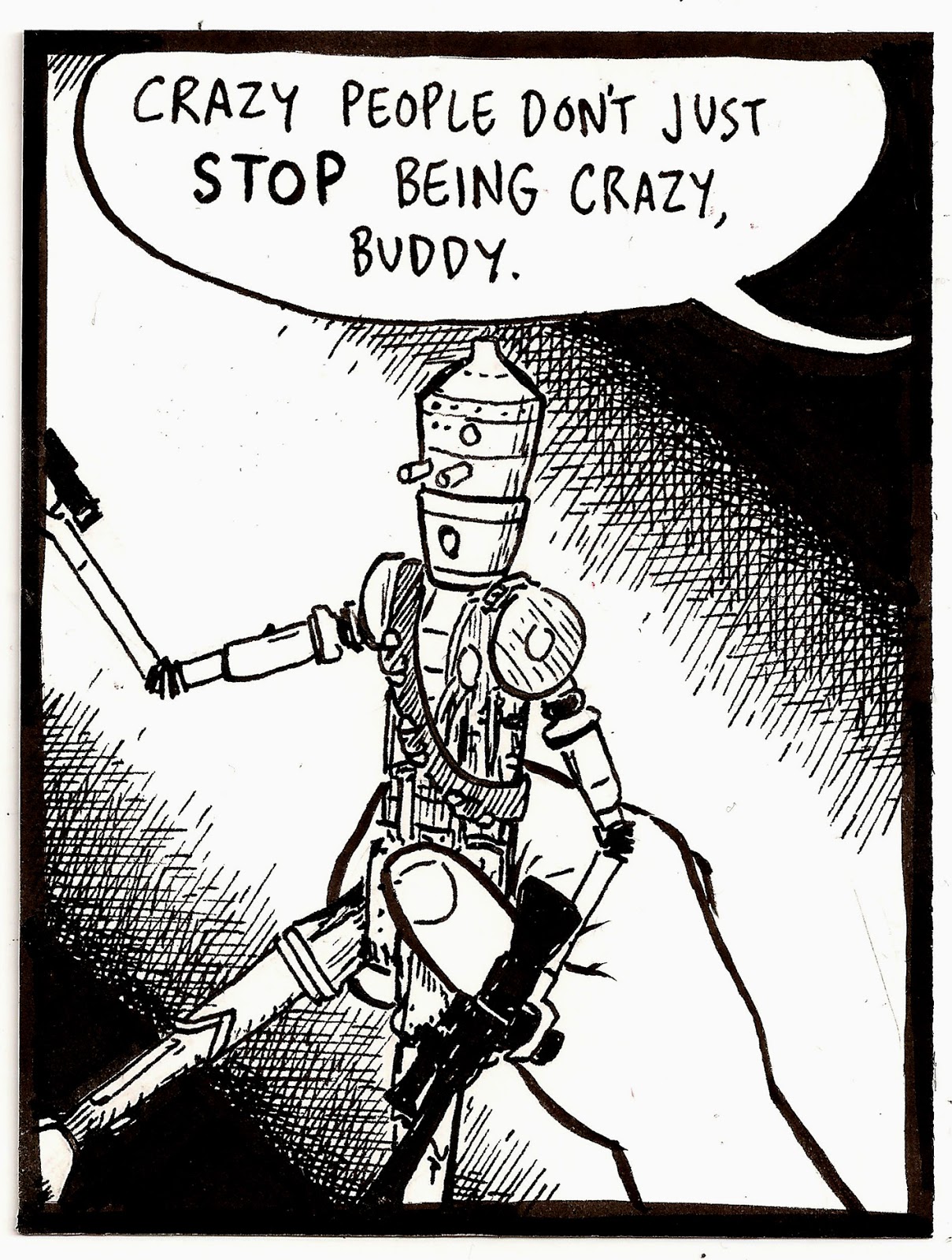
And, in what I hope will be my final wrangle with Photoshop for the week, I've put together the next page of the Matteu story. Things are starting to get tense, now, with a real conflict emerging, sort of...


(Please do click the image so you can read it.)

You may notice the cameo Mike and I are making in that first panel. Two free sets of the Stepan postcards for the first person who can identify our clan costumes! (Use the comments section and your knowledge of the comics Mike and I grew up reading.)

This is around the time when the chronological gaps between tiers started to get kind of long. I think more than a year passed between my two strips on this page. This is what you get when you mix comics with academia, I'm afraid.

Saturday, May 17, 2008

I Wandered Lonely as a Crowd

I'm still coloring that Elfworld story, but I'm finally working on the last page, which is also the first page. You may remember that the first page is set in a bazaar. There's quite a crowd there.


This makes the job of coloring the thing very complicated. I wish I could say that I'd picked up enough facility with Photoshop to make this sort of thing quick and easy; alas, it looks like this page is going to take me about an hour per panel.

Why, a marketplace like this is enough to give a person agoraphobia! (Sorry. I'm sure Mike would have said it if I hadn't.)

I'll post more of the Matteu story tomorrow, by which time I should actually be finished with these postcards.

Friday, May 16, 2008

Comes the Apocalypse

Why does this exist?


And why, Lord, why does it feature Ozzy Osbourne?

The wretched details are found here.

Thursday, May 15, 2008

If Sauron had won...


It's all on!

Comics in Hungary

In April I traveled to Hungary for the first time in ten years. Ten years ago I wasn't reading comics at all, much less making them; and I was certainly uninterested in seeking out comics produced in Magyar, a language that laughs at the non-agglutinating, un-vowel-harmonious simplicities of the Indo-European or Semitic tongues with which I am more familiar.

But this time, when Becca spotted an ad for an exhibit about Hungarian comics, conveniently on view in Budapest right when we'd be there, I was keen to check it out, language obstacles notwithstanding [Edit: See comments for further links, courtesy of Becca]. We had a nice walk along the mighty Danube, passing by the beautiful Parliament building...

...on our way to Margit-Sziget (Margaret Island), a big green patch of land amid the river where it widens, just before narrowing again to divide the originally separate cities of hilly Buda and flat Pest. The exhibit was being held in Holdudvar, a restaurant-artspace on the island. Here's the exterior of the site, with a banner promoting the "Frame Up" exhibit:


As the English-language title shows, the curators of the exhibit catered rather graciously to their non-Magyar-speaking visitors, and a number of the pages were displayed in English translation (so please do click images below to enlarge them unto legibility!). The exhibit was curated by kArton (sic), a gallery dedicated to comics in Hungary, and it featured works ranging from decades-old adventure stories and humor comics to quite recent stories that display a kind of Dark Horse Comics sensibility (by which I mean it's attractive, professional work that happily employs genre tropes without appearing to be swallowed whole by genre clichés or over-corporatized).

One of the artists most responsible for that Dark Horse Comics vibe was
Mátyás Lanczinger, whose sample pages from a detective story called "The Woman in the Yellow Wig" looked like a parody of Frank Miller's Sin City yarn That Yellow Bastard:


Some of the more recent work fell more in the "art comics" column, with the bulk of its interest coming from painterly techniques and whole-page composition rather than storytelling or joke cracking. Unfortunately for this post, I didn't bother to photograph samples from those art comics, both because I wanted to spare my camera battery and because I'm a philistine, apparently. Also, in my effort to record details with my camera, I haven't caught the attractive display of original pages and oversized reproductions in frames that were themselves decorated with cartoons and color. Sorry!

Anyway. Another seeming reflection of English-language comics came in artist Zoltán Fritz's story "Death and the Compass" (or "The Compass of Death," as the kArton website puts it). Based on a tale of Borges (with script credited to "Zorro de Bianco"), its details of mystical arcana (kabbalistic, in this case) and occult urban mapping recall the creepy revelations about London's wicked architecture in From Hell by Alan Moore and Eddie Campbell:


Fritz's story was serialized (in Magyar) in a Hungarian comics anthology called Pinkhell, whose pages also featured Noname by Miklós Felvidéki, likewise on view at the exhibit. In fact, both artists' stories won Alfabéta awards from the Hungarian Comic Publishers Association for "best comics short story (3-19 pages) of 2007." I liked their work enough to buy an issue of Pinkhell despite the language barrier (thankfully overcome in some measure by their visual storytelling skills and by recourse to a Lonely Planet Hungarian phrasebook). Here's a mostly silent page by Felvidéki from the exhibit, since it's the visuals that appeal to me most in his work:

He also tied for an Alfabéta award for best cover of 2007, again featuring his fox-man from Noname:


Felvidéki's skill at visual storytelling comes through in his four-page short story in Pinkhell 3 (a story that communicated its ideas quite well even before I resorted to the phrasebook to puzzle out some of the Magyar). It's a masterpiece of compression and the expressive use of color--or, rather, the narrative use of color, as color is used less to convey a mood than to connect scenes as they play out between past and present, real life and fantasy in the mind of the protagonist. Here's how the first page sets out the method of the story. In the first tier, the fox-man protagonist is speeding along in a car with yellow-green flames on the hood in the year 2007 (if the flames look insufficiently green, I apologize and blame my scanner). The car comes to a drawbridge--

--only to crashland in 1981, as a toy car hurled by his younger self. Note the way the distinctive yellow-green of the car's hood (tinily visible in the second panel above) is transferred to the background of the fourth panel, as the fox-man realizes his mistake, before recurring in the explosive sound effect of the toy's crash against the wall. This sort of passing-the-color-baton to bridge gaps in time, place, and perspective works really well in this story, and it comes together nicely on a final page that reveals the bridge-jumping hotrod of 2007 to be still another fantasy (far from speeding away from pursuers, the fox-man is stuck in traffic; and his car doesn't have yellow-green flames: it's entirely yellow-green, and looks a little sickly).

Finally, the cartoonist whose work appealed to me the most at the exhibit was a member of the old guard, Sándor Gugi, who apparently (according to my friends at Wikipedia) got the idea in the 1950s to produce comics adaptations of literary classics in order to avoid the charge of producing imperialist vestiges of Western cultural trash. Happily for me (as my scholarship is mostly on Arthurian literature), the Gugi comics featured at Holdudvar included his playful take on Lancelot's love for Guenevere. The story is amusing, but what I really loved was Gugi's cartooning. Check out this detail of Lancelot languishing while the wizard Klingsor traps Lancelot's love in a bottle:

Masterful black and white, and an adorable owl. What's not to like? I'm just sorry that this story wasn't featured in the only Gugi collection I could find.

From my outsider's eyes, it looks as if the current Hungarian comics scene is in an interesting place, though the Wikipedia entry on Hungarian comics seems to take a dim view of prospects for the medium and its artists. Be that as it may, with evidence of over fifty years' worth of interesting cartooning on display in a single small exhibit, and a current anthology showcasing quite a variety of approaches, Hungary's comics just might deserve a more optimistic outlook. Perhaps in the future more of us, Magyar or not, can join together in a celebration of comics and declare: "It's all on!"

Monday, May 12, 2008

Color Update on the Stepan Story

I've been coloring the pages out of order, skipping over a few that I thought would present problems, and I just finished my fifth one -- which is p. 7. I think that means I'm halfway through with the work, or at least nearly there.

The page I just finished, as you may recall, is the one that swipes its layout, more or less, from Duchamp's Nude Descending a Staircase. I thought I'd try doing that page with a flat version of Duchamp's palette, leaving some of the painting visible in parts of the background.


What do you think?

Miniature Dogsbody

Page 6 of the Stepan story has a lot of tiny details in it. (It's my own fault. I know.)

Here, for example, is a very, very small image of Kalbi, sitting on the back of the stagecoach.


This is enlarged around 4X for your viewing pleasure.